
No more tea bags for you. Nope. Not going to happen. You go straight to the high quality, right for the good stuff – the loose leaf stuff, nothing less than the SFTGFOP for you. You open up your box and stare at the golden floweriness of the leaves… and then drown them in chemically treated tap water full of who knows what. You take a sip and wonder why your super fine tea doesn’t taste so super. Before you blame the leaves, the company, the farmer, the crop, and the weather, you might want to take a good, hard look at your not-so-good hard water.
Roughly 98% of what is in your teacup is water. If you don’t like the taste of your water, then more than likely you are not going to like the taste of the tea. What I mean is, if your water tastes like you are licking a metal pipe – water that has a lot of heavy metals, chlorination by-products, and other pharmaceuticals – then your cup of tea is going to reflect that metallic/sulfur aftertaste.
The importance of the right kind of water for tea is not something new. For centuries, the Chinese insisted that the best water to use for Dragon Well tea was water from the Dragon Well spring in the FengHuang Mountain region of China. Although, we cannot all have access to the Dragon Well spring, we can reach for the next best thing: filtered water.
PUR, a company dedicated to water filtration systems, sent me their PUR one-click faucet mount filter to put to the test. I decided to do a blind experiment involving four different water sources: the PUR faucet mount water filter, a Brita water filter pitcher that I currently use for tea, my tap water, and my boyfriend’s apartment tap water.
First, I would like to say that installing the PUR filter was very easy. We have a fairly old faucet and I was worried if the filter would attach, but PUR includes four different washer-like attachments so you can choose the right one that fits your faucet. After screwing in the washer, the filter slides in easily to the body of the case, and the whole thing snaps on with one easy click. They really aren’t kidding about the “one-click” process. De-packaging to installation only took about five minutes.
For the procedure I lined up four mugs and four glasses labeling each pair A, B, C, D. Like I said earlier, this was a blind test so I left the room and had someone else fill each mug with a different type of water, with them keeping the key to what water was in what mug a secret. In each glass I measured out and placed 2.3 grams of Adagio’s White Peony white tea. I chose this particular tea because of its delicate taste. I also chose glasses instead of my fancy tea ware because I didn’t have four of the same tea ware pieces and I wanted each batch to be uniform. It is not the most aesthetic set up, but this way each batch was subjected to the same heat dissipation and steeping conditions.
Next, I heated the four mugs in the microwave until the water reached a temperature of 185°F, allowing for a loss of 5°F when hitting the room temperature glasses to acquire the recommended water temperature of around 180°F. Then, I poured each mug of water into the respectfully labeled glasses containing the white tea. I allowed the tea to steep for the recommended seven minutes then decanted the tea into their respected mugs. Finally, I allowed the tea to set for about five minutes in order to be cool enough to taste.
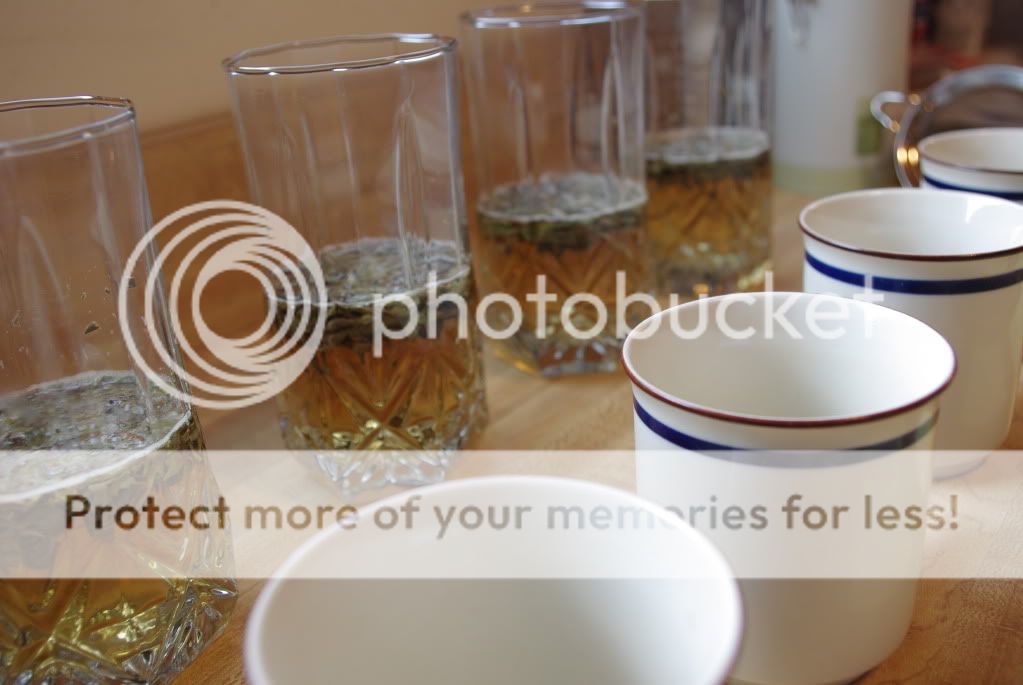
The results were very interesting. I have known for quite some time that water affects the taste of tea, which is why I invested in my Brita pitcher, but I had no idea of exactly how much water plays a role until I tasted each cup side by side. I was very surprised! Here is what I found:
Please remember that even though I have now paired my notes with the actual water source, at the time of the tasting, I had no idea as to what water was in what mug.
(A) PUR faucet mount water filter – It has a strong, full, brisk flavor for being white tea. I can taste the slight fruitiness at the end, along with a hint of sharpness. It is rather dry than the other three, but holds more complex flavors. There was hardly any residue on the side of the mug.
(B) Boyfriend’s apartment tap water – It has a strong flavor but also a harsh bite in the beginning and end. I have a hard time tasting any fruitiness that normally accompanies this type of tea. The sharpness is distracting. The color seems to be the darkest of the four. This one is astringent as well, but not as much as A. There was a lot of residue on the side of the mug.
(C) My tap water – It has a good flavor, but not as strong as A and B or as complex as A. It is crisp with no sharpness like B. I can taste way more of the fruitiness of the tea but less of the other slightly grassy, nutty flavors like in A or B. It is smoother than A and B – not as much dryness – but the finish is flat. There was a fair amount of residue on the side of the mug.
(D) Brita pitcher water filter – This is almost the same as C. This tea has the lightest color of the group. The flavor also seems faint and a little flat. It is crisp and smooth, hardly any dryness. It lacks the body and briskness that A has. There was hardly any residue on the side of the mug.
My conclusion was a hard one to make. I liked the full flavor of the PUR, but the dryness caught me off guard. However, like wine, good tea is supposed to have some dry qualities. I think I am going to avoid ever making tea with the tap water at my boyfriend’s apartment and at my place. As for my Brita pitcher, that one really stunned me. I have been making tea with this water filter for over a year now, and I didn’t see anything wrong with it. I am wondering if something went wrong with the steeping process in this batch. I want to give old faithful another chance before nixing it. For now, I think I am going to use the PUR filter. It is easier to use than my Brita pitcher (which I have to pull out of the refrigerator and refill almost every time I use it) and the PUR filter makes a decent cup of tea.
For my final thoughts, I suggest investing in a water filter of some kind if you want to enjoy delicious cups of tea or even healthier cups of water. By the way, if you are thinking about buying bottled water instead of a filter, don’t! Filters are a heck of a lot better for the environment, so I believe bottled water isn’t even an option. So I don’t have to go through my diatribe of why I think bottled water is bad, just don’t do it… or I will make you hug a tree!
Sunday, February 6, 2011
The Water Experiment

Monday, January 17, 2011
Arbor Tea's Dragonwell Review
Type: Green
Origin: China
Price: Free sample (regular price - $10.95 for 3oz.)
Vendor: Arbor Teas
Brewing Method: Per Instructed - 1 teaspoon of leaves, 1 cup of filtered water, heated to 180°F, steeped for 2-3 minutes
Overall Score: 3.0 out of 5
Dragonwell is a green tea from China. The dry leaf aroma, however subtle, is slightly woody and nutty. The roasted aroma is prominent with this tea. Long, flat pieces in about every shade of green slide out of the package and onto the plate. The leaves are not as big as I have seen for a Dragonwell, however. There are a fair amount of tiny bits and broken pieces in this bag.
The aroma coming from the gaiwan while the leaves are steeping is a nutty and buttery combination. The liquor is a pale yellow color.

The taste is a little bitter at first. It has an astringent, nutty bite to it. Hmm… this seems to be a harsh tea all the way around. There is just something that feels kind of stabby on the tongue. The aftertaste is very dry until about five or six seconds later then the creamy, buttery background shows up.
By the time I reached the bottom of the cup, the taste eventually grew on me… a little. It has a heavier body than most greens and it packs a bitter punch. This is an interesting tea, but I am just not sure this would be my go to Dragonwell. I will play around more with time and temperatures to see if it changes the overpowering roasted flavor.
Friday, January 14, 2011
Behind the Scenes
What exactly goes on during a tea review by yours truly? Well, let me show you.
This is the set up. It's not fancy by any means, but it is what works for me. A simple folding table holds my tea tray, tea towel, and fu dogs. My laptop, external hard drive (where I keep my pictures and written reviews), and cell phone (timer) sits on a folding TV tray and the other TV tray is used for the camera tripod or extra placement space. When I sit in the folding card table chair, to my right is where I store my tea, kettle, and other utensils.
I have a flexible outline in which I review tea. I try to keep the steps the same so I can review each tea the same way, but I try not to make it boring, as well. I open the bag that contains the tea and note the aroma. I pour some of the leaves into a bowl or onto a plate and give the leaves a few more sniffs for a better description of the aroma. At this time I note the recommended water temperature and prepare and start the kettle. While the kettle is doing its thing, I take pictures of the dry leaves while also writing about the appearance. By this time the water is up to temperature so I put the recommended amount of leaves into a teapot, gaiwan, kyusuu, or whatever I choose to use that day and then pour in the hot water. As it is steeping I note the aroma coming from the brewing vessel. I decant the tea when it reaches the suggested brewing time and note the color along with the aroma again. While the tea is cooling I take pictures. Then comes time for tasting. I usually go with my gut on this part and write what first comes to mind... as in what the flavors remind me of. I finish writing the review, edit the pictures, upload the pictures, put the pictures in the edited blog post, and finally post the review for all to see. After all that, I drink the rest of the tea if I like it, and then wash the tea ware.
And... that's it. It doesn't sound like much but this whole process from set up to wash up is about an hour per tea. I have always thought that it's easier to pop out tea reviews one after another if there are no pictures involved... but I think it gives something extra to the blog. You can see that I actually made the tea. You know that I didn't just throw some random descriptive words together and call it a review. I care a lot about the reviews I write and the pictures I take, so I take the time to do a good job... but, as a result, I can't get them out as fast as other bloggers can.
Thursday, January 13, 2011
Arbor Tea's Earl Grey Review
Type: Black
Origin: China and India
Price: Free sample (regular price - $9.95 for 4oz.)
Vendor: Arbor Teas
Brewing Method: Per Instructed - 1 teaspoon of leaves, 1 cup of filtered water, heated to 212°F, steeped for 3-5 minutes
Overall Score: 3.6 out of 5
Earl Grey is a mix of Chinese and Indian black teas flavored with bergamot oil. When I open the package, I can immediately smell the citrus bergamot – it is rather strong. And… that is pretty much all I can detect from the dry leaves. If I put my nose anywhere near the leaves it gets pummeled with the aroma of bergamot. The leaves are small, curvy, dark brown pieces with bits of orange color throughout.
The aroma of the freshly made tea is all about the bergamot, although, I can faintly smell the malty black tea in the background. The liquor is an orangey-copper color.
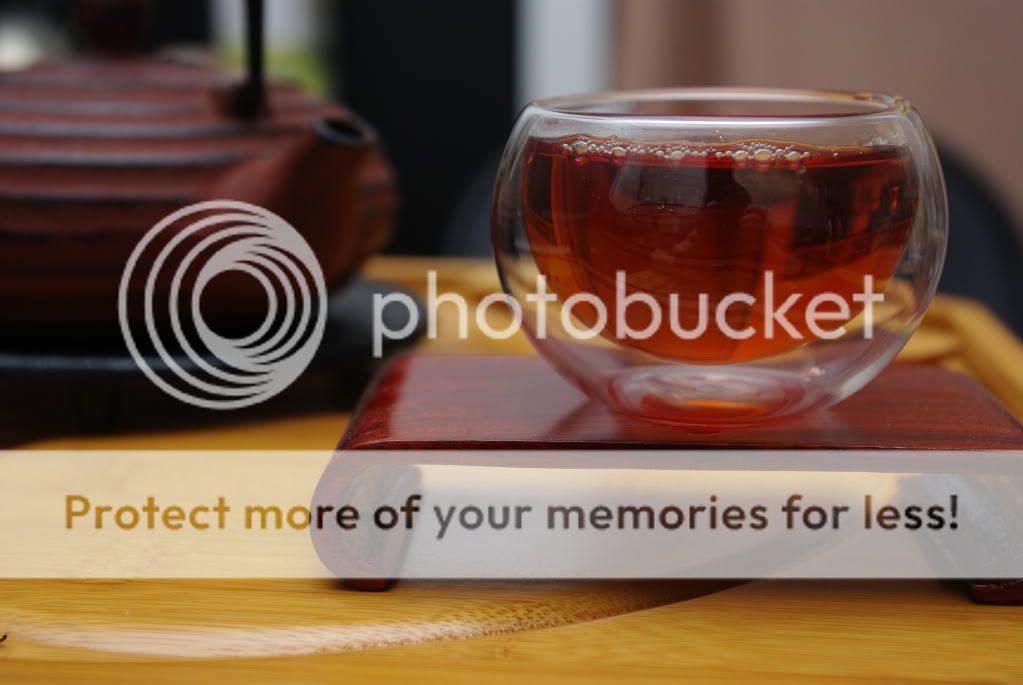
The taste is a bit harsh at first. Between the citrus and the black tea, it is quite astringent. The second and third sips reveal the boldness in this tea. It is not a very complex tea; I just go back and forth between the bergamot and the slight smokiness of the black tea. However, the flavors that it does hold are not shy about letting you know they are there.
I wouldn’t say this tea is bitter, but very acidic and slightly sweet tasting because of the bergamot. It tends to dry out the mouth quickly. I am not sure about this one. It is not one of the best Earl Grey’s that I have had, but it is not bad either. It is just sort of a meh... but at least the price is fair.
Friday, January 7, 2011
Unnecessary Tea Accessories
For those who are new to the wonderful world of tea and just starting a tea and tea ware collection, the vast array of options can be a bit overwhelming. Please allow me to spare you some terrible headaches. The following items are things that I deem rather unnecessary as far as tea accessories. Of course, you always have the final say on what gets added to your list of must  have tea items.
First on my black list is the variety of “infusers.” It has become a reflex to automatically cringe when I see or hear that word. There are tea ball infusers, spoon infusers, stick infusers, etc. What it all comes down to is relentlessly shoving and over packing poor, innocent tea leaves into a stainless steel cage and plunging them into hot water. While you are at it, you might as well let out an evil laugh and shout “there are ways of making you talk!” A better solution is to not even spend the money on these sadistic contraptions. Remember, if you are going to use whole leaf tea, then the leaves need a whole lot of room (in order to expand and steep to their full potential). Most infusers are two small to provide the space needed for large leaves. Therefore, simply put the leaves into a teapot - minus any infuser baskets that might have come with the teapot - pour hot water over the leaves, steep, and then pour the tea through a strainer and into your teacup. If you think about it, it does not take any more or less time to clean out an infuser than it does a teapot. It would actually take longer to stop what you are doing and pack the leaves into the infuser just to have to clean them out later. Not only does this accessory not save you time, but it now gives you a weak cup of tea.
The same concept goes for “T-Sac’s” or filter bags in which to put loose tea. That is logic I have yet to understand. You break out of the normal bagged tea routine and buy loose leaf tea - awesome - then you scoop out some loose leaves and put them… into a bag. Uh… ok… moving on.
As long as we are on the subject on bags, I will mention tea bag squeezers and tea bag rests. Don’t use tea bags and you won’t have a use for these items. It really is that simple.
Finally, the last thing on the list is the tea cozy. Maybe it is because I’m not really a girly girl. Maybe it is because I am not stylish. Maybe it is because I am not the type of person who tries to make her dog wear clothes. Whatever the reason, I think tea cozies are absolutely laughable when it comes to tea accessories. Tea cozies are nothing more than clothes for your teapot. But it keeps the tea warm… oh, really? Really?? What I have found is that keeping tea warm and not letting it naturally cool makes the tea continue to cook. Even if you strain your tea with a fine, mesh strainer small particles are still going to find their way through. As a result, if you keep the water hot, it is going to continue steeping the tea which will result in a bitter brew. This is also the reason why I  quit using my vacuum seal travel mug – it kept the tea so hot that it changed the flavor profile by the time I had removed the lid to let it cool enough to drink. I hate the fact that there is a small window in which tea is at the perfect temperature to drink. However, letting the tea cool naturally does not allow it to continue to steep as much, making it taste a heck of a lot better. Some have also said that they use tea cozies for storing their teapots. I say, why would you store them? Display them proudly! When I am not using my teapots, they have their own special spots on shelves to be viewed by all.
Image Reference Links: Tea Ball, Tea Stick, T-Sac, Tea Cozy
Thursday, December 30, 2010
Rishi Tea’s Hong Yue Review
Type: Black
Origin: Taiwan
Price: Free Sample (regular price - $11.00 for 50 grams) LIMITED SUPPLY!!
Vendor: Rishi Tea
Brewing Method: Per Instructed - 1 teaspoon of leaves, 1 cup of filtered water, heated to 195°F, steeped for 3 - 4 minutes
Overall Score: 4.9 out of 5
Hong Yue, also known as Ruby Black, is a rare and unique tea from Taiwan. The fresh aroma from the bag is incredibly fragrant! It reminds me of chocolate covered raisins – sweet, slightly grape-like. There is something a bit tart about it as well; maybe dates or cranberries. The term “fresh” keeps coming to mind when smelling the leaves and I think the reason is that it lacks a smoky quality that many black teas have which makes it even more unique. The dry leaves are black, long, twisted, wiry, almost uniform pieces. The leaves are rather large for being a black tea.
The raisin aroma is brought out more while the leaves are steeping. It also has more of a fruity, candy scent. The liquor is a gorgeous copper color.

Oh my… I don’t want to write anymore. I just want to sit, sip this tea, and think of nothing else.
The taste is fantastic! I have never tasted a black tea with so many fruity notes. A raisin or grape-like flavor is prominent, followed by a currant or cranberry tartness, and then a candied sweetness. It is not spicy or smoky or bitter. It is, however, quite astringent… which I noticed by the third sip. The boldness equals that of an Assam tea but without the smokiness, of course.
As I noted next to the price, this tea is in limited supply. This is truly something not to pass on if you want a high quality tea experience.
Speaking of, have you noticed the adorable white, speckled tea pot in the picture above and in my last couple of reviews? Rishi Tea calls that a Tsuki Teapot, Tsuki meaning “moon.” I won this little beauty back in February from a contest that Rishi Tea held. I love it! It is the perfect size for one person and, because of the firing process, each teapot produces different speckles so no two are alike.
Wednesday, December 29, 2010
Some Advice on Tea Storage
I was reading an article on tea storage advice and did a double take when I hit the section about storing tea in the refrigerator.
Do NOT do that!
There are several things wrong with storing tea, even in an air tight container, in the refrigerator. First, refrigerators house other food odors which could be absorbed by tea leaves. It is bad enough that some teas are overly  flavored and scented to begin with, would you want your tea tasting like everything else in your refrigerator, as well? Second, if you place tea in an air tight container, you are also trapping room temperature air in the container. Then you place the container in the refrigerator. A couple of days later you are craving some yummy delicious tea so you grab that container from the refrigerator, open it, scoop out what you want, and close the container. What just happened is you introduced warm air into a cold container. When you put the container back into the refrigerator this is going to produce condensation and the moisture will lead to mold.
Thus, the benefits of the slightly extended shelf life versus the potential risks are just not worth it.
Basically what tea storage comes down to is protecting it from its two enemies: light and air. Store your tea in air tight containers (or at least make the container or bag as air tight as possible) and store those containers in a cool, dry, dark place. Be careful when storing tea in kitchen cabinets because the same threat of food odors in the refrigerator can come from the spices in the cabinets, as well. The ideal place in the kitchen is in the cabinet away from spices and away fr om the oven as smoke and fumes from cooking could absorb into the leaves.
If you have lots of tea (like the tea freak writing this article) the best practical place to store tea is in a cabinet in another room other than the kitchen... for example, the dining room or living room. This way, the tea is safe from light thanks to the opaque bags and containers plus the doors on the cabinet and the precious leaves are far away from any food odors that it could absorb. Keeping the tea at the same temperature as the rest of the house keeps moisture from forming and developing mold. It is not the perfect set up, but it works.
Ok, if you just insist on storing tea in the refrigerator for whatever reason, allow me to suggest something else. Separate the tea leaves into individual serving sizes and place each serving into a small sealable bag. Then, place the bags into the freezer. When you want to use those tea leaves, take out as many servings as you need and use all of the tea you take out. Do NOT put those tea leaves back into the freezer once you have taken them out.


